Come in here in the morning and you can feel the beat. Conversations overlap. Someone is humming. The indignation is so vehement due to the lost crayon. The Akidamy does not regard this noise as a disruption. Children are not intended to sit round and listen like sponges on the counter. They move. They test ideas out loud. They disrupt themselves in the stream of thought, and circle round. I was told one day by a child that he wondered whether the shadows were lonely or not? the question was asked all day, and was brought up during play, snack, and a dispute over dinosaurs. No one rushed past it. Curiosity prevails.
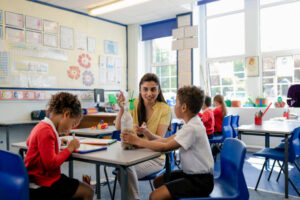
Education comes in disguise of banal things. Play is not a rest to thinking but where thinking has been given a push-up. Arguments of balance spawn out of blocks. The social experiments are made out of dress-up corners. Children assign roles and change the rules, overturn the rules and re-create them. When the need arises adults will not steal the show but will be close by. Their questions are less commanding than hinting. And they do not necessarily say anything, which is more challenging. Patience of a child comes out when the two people are patient.
Language development here is alive. Stories are pouring out of books and crawling at the ground. The process of reading is accompanied by sound effects, dramatic pauses, and bursting. Writing starts messy. Lines wobble. Letters lean. Meaning arrives anyway. A list of loops might be a storm, a song or a grocery list of imaginary creatures. Children report labor in an arrogant and passionate manner. Nobody hurries to give a correction to spelling before the message has reached its stretching legs. The words are empowered when it is given time to wander.
Numbers do not enter as a foreigner. Making counts happens through placement of dishes with the use of habit. Measuring is essential whenever one is making baking experiments that turn out to be a glorious failure in other occasions. Toys sorting will turn into strategy. Math is applied before being formal. Giving away snacks and then asking them back is one of the ways, through which a child learns subtraction. That lesson sticks. It was something that was experienced, not on a printed paper where one is expected to write in straight lines.
Emotional learning is not less important. Emotions are managed as climate. They change. They pass. They can be talked about. Adults do not experience panic when they are frustrated. They slow down. They name what they see. Children also learn that being angry is not the reason that they become bad and sadness is not the reason that they become weak. War turns to conversation, to be difficult at times, to be generally honest. There is no pressure on the use of apologies. Listening is an art rather than a motto.
The environment silences teaching all day long. Materials sit within reach. Decision is not ornamental. Silent places are to think or gaze at the ceiling. Noises and movements are found in active spaces. Children are educated on how to manage themselves as they are allowed to experiment. Independence is shaped without proclamations. One day a child will be able to fill his or her own glass and sit back waiting to be applauded. It comes, subtle but sincere.
It is not the norm that families need to be taught that there are changes. Better questions at dinner. Longer focus during stories. One has the impulsive urge to extend an aid, and then a belief of how the lending has to occur. The learning a leak and child pursues him home. Humor tags along. And when children are not intimidated on the level of being threatened, they are funny. In this instance, education is a sham of being genteel. It seems to be honest, rather curious and a bit rough, which is very much appropriate to the mind that is growing up.