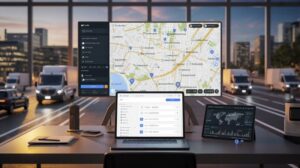
Take a whiteboard, a piece of paper, and a cup of coffee and imagine the day being planned by a dispatcher. It consists of fifteen stops, three vans, and one driver who does not like crossing some bridge after 4 p.m. Change of plans: this time draw up 200 stops as opposed to fifteen. Spread sheets get lost very quickly. Small mistakes happen. Guesswork increases. Fuel costs slowly rise. What began as a straightforward plan turns out to be a stress and an ineffective plan.
A route optimisation software will eliminate much of this confusion. It determines the optimum route of stops depending on the distance, traffic, delivery time range, carrying capacity of the vehicles and availability of the drivers. It makes such calculations within a few seconds. What a person could have spent an hour strategizing on can be done almost instantly by the system.
The benefits go beyond speed. In shorter and better-planned routes, the fuel consumption is reduced. Drivers do not take much time going round or hunting addresses. The number of overtime hours is minimized as the drivers complete their tasks sooner. Delivery windows are more accurate to the customers and this creates trust. By trusting a given company, the customers will be willing to go back and refer others to the service.
One of the logistics managers told me that his firm thought they were already efficient. Having tried routing software, they found out that they might save almost 20 percent of daily miles. They failed to employ new drivers or to purchase new vehicles. They just resorted to smarter route planning.
The power of the route optimisation software lies in the fact that it can compute numerous factors simultaneously. It puts into consideration road restrictions, traffic jams, zones around schools and even the weather. It acts as a strategic planner that considers multiple steps in advance as things keep on evolving.
It is even more powerful due to real-time updates. In case something happens and a highway is blocked, the system may give an automatic suggestion of another route. In case a new order is introduced in the middle of the day, it will be able to fit in the order without significant disturbance. The dispatchers do not need to react to problems all the time but can concentrate on planning and better operations.
Small companies are no less favored. The time spent traveling to the nearby cafes can be minimized by hiring a local bakery to deliver the goods. With fewer employees, a small repair firm will be able to make more calls in one day. Productivity is important on all levels.
Clarity and rationality of routes is also valued by the drivers. They have reduced the number of last-minute changes in their workdays and less confusion. Reduced stress usually results in increased job satisfaction that contributes to the retention of the experienced drivers in the companies.
Data As the system accumulates over time, it becomes valuable. The managers are able to observe trends, including those areas that move more slowly during specific days. People begin making decisions which are founded on facts rather than guesswork.
The use of route optimisation software transforms the operations of delivery problems daily, which comprise stressful problem solving, into a regulated and efficient movement. Every minute and every mile in the delivery business, profit is influenced. Intelligent routing assists in securing the two.