You know you were on Instagram and you saw those shiny garage floors and thought, “I want that too. Fair enough epoxy flooring installation are amazing to see- almost unbelievably good looking on top of a concrete floor. However, there is a disparity between what is on the Pinterest image and the reality that makes many individuals very surprised.
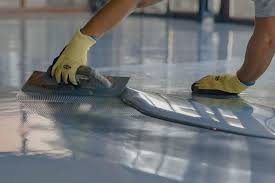
Surface prep is 80% of the job. Seriously. The epoxy per se is nearly incidental. When you put a layer over a dusty, oily or wetened slab, you are basically wrapping a time-bomb. Within months, the floor will blister, peel and be an embarrassment. The concrete must be clean and dry and profiled before you crack open a single can.
What does “profiled” mean? It must be a rough surface in such a way that the epoxy will be able to adhere to it. Diamond grinding equipment is normally used by professionals. Others use acid etching, which also works, but only when the concrete is so porous that it takes in the acid, and only when the acid is completely neutralized afterwards. One step ahead, and you are in trouble.
The hushpuppy in epoxy jobs is moisture. Concrete appears to be solid but it breathes. The bond between the coating and the slab will disintegrate with time as a result of water vapor that will be pushing it upwards. The easiest test of all is the plastic sheet test, which is the same procedure except that you stick the sheet to the floor overnight and see whether it condenses beneath it or not, and then you save yourself a very costly rework.
The issue of temperature is a big thing. The optimum temperature of most epoxy products lies between 50o F and 90o F. Beyond that range the curing becomes very slow or ceases. APPLY over it and the working time of the mixed epoxy is reduced more quickly than you had previously anticipated. There is nothing as degrading to the first-time photographer as witnessing his stuff being unwrapped as he continues to roll it.
You will come across three major categories of epoxy systems: water-based, solvent-based and 100 percent solids. Water based are simpler to handle and less fume producing, but they are thinner. Solvents Position the product deeper into the concrete. 100% solids epoxy is the richest and strongest, it is the one most commercial floors use, and has a very steep learning curve, but has virtually no room to error once it is mixed.
Another truthful experience goes as following: with an epoxy system you are asked to mix the resin and the hardener in a specific proportion and then to consume them within the pot life time. Stir the ratio improperly and the coating will never cure. It stays sticky. Permanently. That is no hypothetical, it occurs to individuals who look at the measurement rather than weight them.
Cast flake systems are not that unpopular in vain. You pour colored chips into the wet epoxy, and drop them like confetti, and you wind up with a floor that conceals dirt, gives it a better texture, and appears to be truly sharp. The secret is to slather them over the base coat, and in a uniform manner, before the latter begins to skin up. Once that cures, remove the flakes and put a clear topcoat. The industry standard is two top coat applications. The shortcut is one of the coats you will notice in two years.
The cracks of concrete are an entire different discussion. Epoxy is rigid. The concrete below is not. When there are already existing cracks in the slab and they continue to move; expanding and shrinking as the temperature changes, the coating of epoxy that covers them will also crack eventually. A crack filler will assist but it is not magic. In the case of active cracks, a more flexible polyurea or polyaspartic coating could be more durable in the long-term.
The smell can be one of the things that are surprising people. Epoxy which is solvent based is not subtle. You must have actual ventilation, windows blown open, fans turned on, respirator going. Not a dust mask. An organic vapor respirator cartridge respirator. The idea of working in a stuffy garage and having poor ventilation is truly disgusting and risky.
The waiting game is real. Once the final topcoat is applied you are usually dealing with 24 hours on the topcoat before a foot can tread on it and 72 hours at least before you can lay a car on it. It takes as long as one week before the complete cure of some products occurs. Hurrying is one of the top five mistakes. The floor appears dry prior to being ready.
In case of hiring professional crew, you may ask them what method of prep they use. When they tell them that they will acid etch without verifying the presence of moisture and testing the current surface, it is a red flag. Question number of coats that they are adding and the total dry film thickness. Good crews are aware of such numbers. Any person who speaks in mere platitudes such as we do it right without any specifications is peddling hope and not quality.
It is definitely not impossible to install it yourself in a garage or basement floor. But enter knowing that it is a two-day minimum job, usually more so, and that you will not have much room to spare. The floor that you come up with represents all the choices you made during the prep stage. Shave off the corners there and not all the high grade topcoat will help you.